Upper Arlington's Median Price Describes a House That Barely Exists
August 6, 2026
August 6, 2026
Pull up any portal and Upper Arlington reads as a roughly $610,000 to $620,000 market. Homes sell in under a month. Three quarters of the buyers pay at or above ask. If you have been comparing this suburb to Dublin, Powell, or Worthington from a spreadsheet, the numbers look tidy.
The tidiness is the problem. That median is the arithmetic middle of two markets that behave nothing like each other, stacked on the same streets and often on the same block. Understanding which one you are shopping in matters more than the headline number, because the two markets set each other's floors and ceilings in ways that quietly reshape what your budget actually buys.
Recent snapshots put the citywide median around $610,000 to $620,000 in the spring of 2026, with roughly 25 to 28 median days on market and sale prices landing near 103% of list. A tighter February 2026 MLS cut of the Upper Arlington City School District showed only 23 active homes, 0.6 months of supply, a $550,000 median, and 99.7% of original list price received.
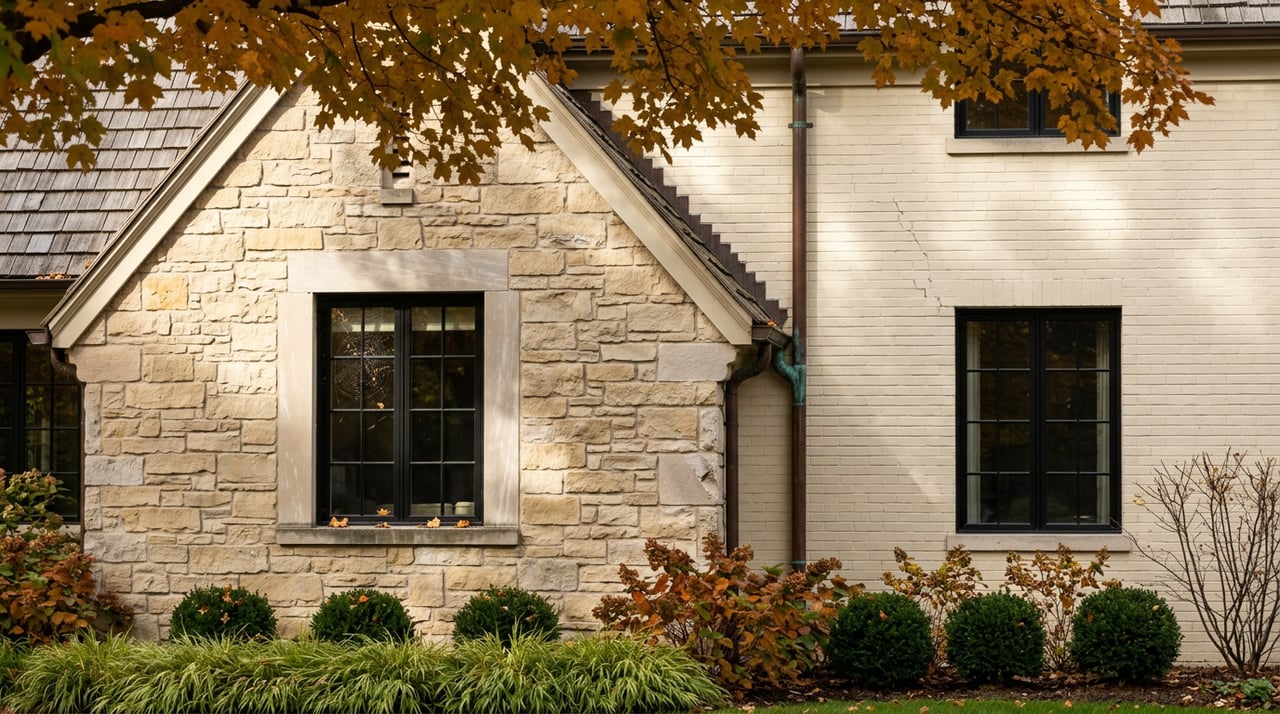
Now look at what is actually inside that pool. Roughly 73.7% of homes are detached single-family, 79.4% of housing is owner-occupied, and the median construction year is 1959. The stock is mostly mid-century ranches and older colonials, many carrying updates from three or four owners deep. Sub-area price bands from local MLS data help translate the median into something concrete: townhomes and entry ranches run roughly $350,000 to $475,000, mid-century ranches between about $475,000 and $750,000, larger updated colonials in the $700,000 to $1.2 million range, and historic homes in South of Lane along with new builds anywhere between $900,000 and $2 million or more.
The $610,000 median is what you get when you drop that entire distribution into a blender. Very few homes actually transact at it.
The second market is redevelopment, and its economics are unusually well documented for a suburb this size. The city's 2025 CommunityScale housing study puts hard numbers on the mechanism. Construction costs run $200 to $300 per square foot, land prices have hit a $1.3 million per acre median for lots redeveloped in the last five years, single-family redevelopment typically sells above $1 million even for smaller homes on smaller lots, and larger new builds on larger lots are usually delivered at $1.8 million or more.
That land figure is the one to sit with. A builder writing an offer on a tired ranch in a desirable pocket is not underwriting the house. They are underwriting the dirt against a finished new-build resale of at least $1 million. Once a few of those trades close on a street, every comparable lot inherits a floor priced off builder math, not off the condition of the existing home.
Two markets, same block:
| Renovated resale track | Redevelopment track | |
|---|---|---|
| Typical age of house | Built 1930s to 1970s, updated | New construction on a scraped lot |
| Buyer | Owner-occupant | Builder, then owner-occupant |
| Price band | Roughly $475K to $1.2M | Roughly $1M to $1.8M+ |
| Competition | Other families | Cash-strong builders using land math |
| What sets the price | Condition, updates, layout | $1.3M/acre land + $200–$300/sf build |
The redevelopment track pulls the resale track upward whenever the two overlap, because a seller with a plausibly buildable lot rarely accepts a resale offer when a builder is a phone call away.
This is where the mechanism bites hardest. A household with $800,000 to spend arrives expecting the city's median to be their center of gravity. What they encounter is a narrow slice: updated ranches and mid-sized colonials that a builder has already declined to buy, in condition that is livable but rarely turnkey. The turnkey inventory at that price sold in ten days and closed above ask. The next tier up is a new build starting near $1.2 million.
Named pockets help sharpen the picture. Waltham Woods leans toward newer construction and resells strongly. Brandon draws consistent demand from families who want mid-century footprints on interior streets. River Ridge, developed post-war, is where the more accessible ranch stock still surfaces. South of Lane is where the historic-and-new-build barbell is most visible, with 1920s to 1940s Tudors and colonials sitting a few doors from freshly framed transitional builds priced at two to three times the older home's last sale.
The practical read for a buyer in this squeeze: budget for either condition or location, and stop expecting both. If schools and walkability are the priority, the winning offer is often on a well-kept but unremodeled house, with a renovation reserve set aside. If finished space matters more than a specific street, the same money buys considerably more house a mile or two outside the district in Clintonville, Hilliard, or northwest Columbus.
The mirror image applies on the listing side. Owners of older homes on above-average lots have two audiences, and the wrong pre-listing decision can cost real money in either direction.
Overinvesting in a full renovation on a lot a builder would happily scrape is the more expensive mistake. The renovation dollars come out of the resale price with a discount, because the next owner may still tear the house down within a decade. Underinvesting in cosmetic prep on a house that clearly is not a teardown candidate is the more common mistake. In a market where a February 2026 MLS snapshot showed 0.6 months of supply and 99.7% of original list price received, the resale buyer pool is still deep enough to reward paint, landscaping, and functional repairs generously.
The question to answer before you list is which pool you are in. Signals that point toward the builder pool include lot depth or frontage that exceeds the block average, corner positioning, mature trees that a buyer would pay to preserve, and a home whose systems are approaching end of life. Signals that point toward the resale pool include a floor plan that already opens up sensibly, updated mechanicals, and a lot that would not deliver meaningfully more square footage under current zoning after setbacks. Before starting any pre-listing work, remember that the city requires permits and inspections for new construction and certain remodeling or home improvement projects, and the 2026 Street Reconstruction Program will affect curb, gutter, and driveway apron work on several neighborhood streets this year.
The right answer determines pricing strategy, staging spend, and whether the listing goes to the MLS first or to a builder shortlist first.
The CommunityScale analysis makes one more point worth carrying into any offer. Ownership and rental vacancy rates in Upper Arlington sit below what is considered healthy for a market, which produces pent-up demand and households that do not form. The city has retained families well but faces challenges keeping young adults ages 20 to 34 and empty nesters ages 50 to 64, both of whom show preference for walkable, urban-style living. That translates into two persistent price pressures: builders keep bidding for lots because finished new builds keep clearing at $1 million and up, and downsizers keep hesitating to list because the alternatives inside the district are thin.
Neither pressure resolves quickly. Both are worth pricing into a decision that is meant to hold for five or ten years.
Is the citywide median misleading everywhere in Upper Arlington, or just in certain pockets? The gap is widest where redevelopment is most active, which today includes South of Lane and portions of the older streets closer to Lane Avenue and Tremont. Interior sub-areas like River Ridge and parts of Brandon still trade closer to the median because builder activity is lighter there.
If I buy an older home, how do I know whether I have paid a resale price or a partial land price? Compare the sale to two comps: a recent updated resale of similar footprint, and a recent teardown transaction on a similar lot. If your purchase sits closer to the teardown comp, you have effectively paid for the land, and your renovation choices should assume the next owner may too.
Does the city cap how big a replacement home can be on a redeveloped lot? Yes, through zoning, setbacks, and lot coverage rules administered by the Board of Zoning and Planning. That is why builders target specific lot geometries. A wider or deeper lot supports a materially larger finished home, which is why land prices per acre are not uniform across the city.
Is now a bad time to buy at the top of the resale band? The risk is not price direction. It is opportunity cost. A $900,000 buyer competing against a builder at the same number gets a used house; the builder gets a lot they will resell for more. Understanding that trade in advance is worth more than any single month's market snapshot.
The pattern behind Upper Arlington's numbers rewards buyers and sellers who read the mechanism, not the median. If you are weighing a move into the district or a decision to sell a home you have owned for decades, Oliver Chapman can walk the specific block, the specific lot, and the specific offer strategy with you. Let's Connect.
Stay up to date on the latest real estate trends.
Oliver Chapman is committed to building lasting relationships through honest communication, local expertise, and personalized service tailored to every client. From first-time buyers to experienced investors, clients receive dedicated support designed to simplify every step of the real estate process. Contact Oliver today to discuss all your real estate needs!